

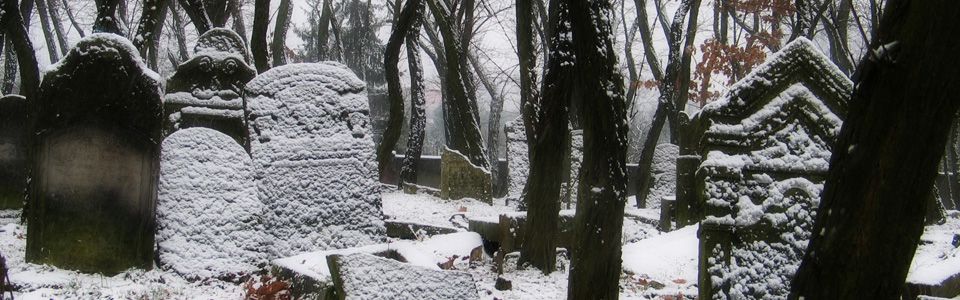
Jewish cemetery in Zduńska Wola
Zduńska Wola is not already the town without Jews!
When in 1998 year I began assembling the materials for my M.A. dissertation I only knew a little about the Jews of Zduńska Wola. Indeed, the teachers at the elementary school did not deal with that topic at all. I do not remember my history teacher saying the word ‘Jew’ ever. In the nineties, following the fall of the USSR, we came to love all what is ’western’’. However as before, our new history teacher did not mention that Jews had lived in our city. All the information about the former residents of Zduńska Wola comes exclusively from my family remembrances. Also the love of the ‘western’ world was not easy: like most youth in this small town, I did not know any foreigner. There were no meetings between Polish and foreign youth. And we still had to learn the Russian language (which in fact became useful many years later ).
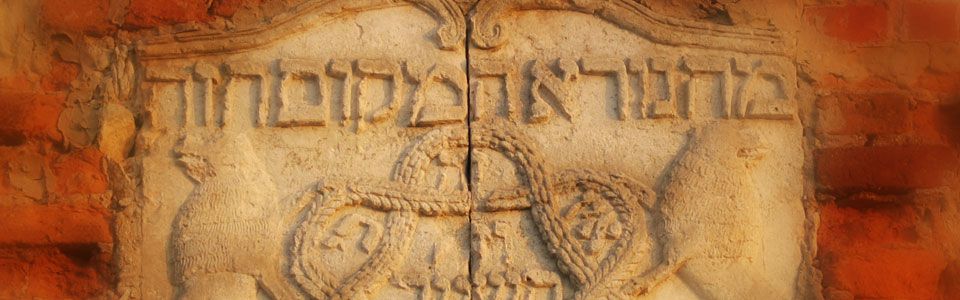
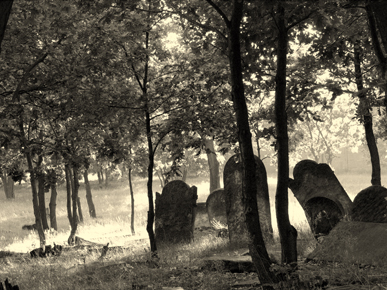
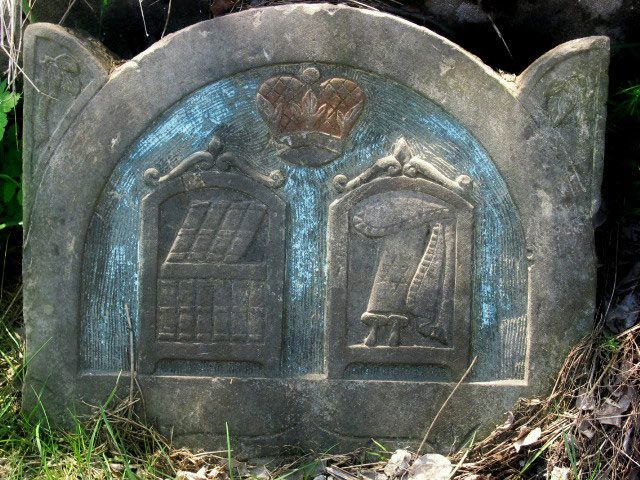
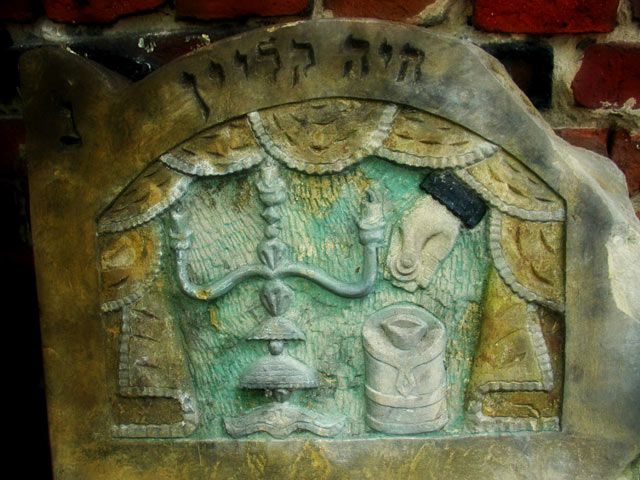
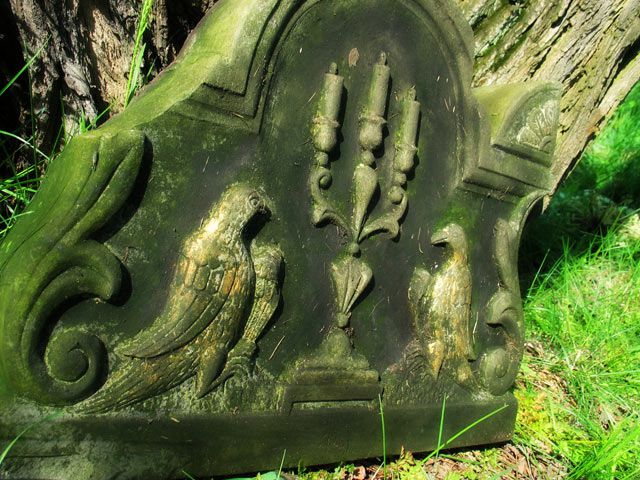
Unaffected by these events, the Jewish cemetery lasted but was often vandalized. Despite this, it always reminded me of an enchanted garden, in which among the greenery an unidentified artist put his stone sculptures. As a child I often visited there. Together with friends we invented stories based on the sepulchral symbols. Some day, in high school our painting teacher led us there and told us that exotic letters and mythical creatures would arouse our imagination and be an inspiration for our future artistic works.
 Today I can clearly say perhaps paradoxically, that the most wonderful people I know in my life I met thanks to this cemetery. In Jewish culture a cemetery is named by any of the following names: beit ha-kwarot – the house of graves, beit olam – the eternal place,– the good place, beit ha’haim – the place of life, beit moed le-kol hai – the final place for all living. To me, it is a good place, place of life. In 1998 I first met Asher Ud (Sieradzki) 1, who arrived in Zduńska Wola with a group of youngsters from Israel.I wondered why Asher was doing this and I believe that the most appropriate answer was that suggested by Louis Armstrong when he was asked ‘What is Jazz?’: ‘Man, if you gotta ask, you’ll never know!’. Every year Asher brings groups of pupils from the Israeli schools to Zduńska Wola.. It is his way to answer questions and to bring closer to them the tragedy of the Jewish nation in WW II. Since they did not experience the Holocaust, Asher wants to show them those places, to tell them about those days so that they will never forget and they will transmit this memory to the next generations. I wanted that as well, but also something different: to bring our common history closer to Zduńskawolers.
One day a friend from Israel told me about his very first visit to Poland. About the worries he had when he set foot on the Polish ground. As he had to find a taxi to take him to the Jewish cemetery in Lodz, to find the graves of relatives, he realized that he was watching suspiciously the taxi-drivers, trying to choose one that would not look like an anti-Semite! But … how does an anti-Semite look like?!
That same year we already had begun to organize a new type of lessons in Zduńska Wola’s schools. We tried to show that there had been nearly 200 years of common history between Poles and Jews in our town. All the schools accepted us very warmly and with time we began organizing similar lessons directly on the cemetery grounds. Co-operation of our schools with Israeli schools developed and documentation activities were organized in the necropolis. Following one of these meetings, I clearly remember that one Polish woman said: ‘It is so strange, they look as exactly the same as us!’. Amazing, isn’t it? How should they look like?!
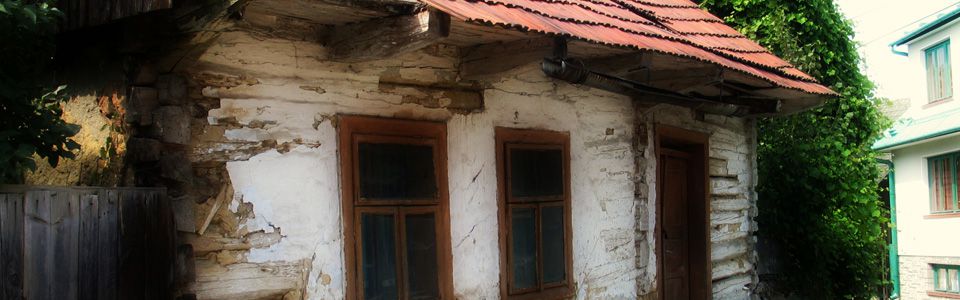
Our grandfathers built Zduńska Wola. They lived in the same houses. Tragedies took place in Zduńska Wola and hit both Poles and Jews. In 1905 a big fire erupted in town, in one of the tenement houses on Łaska street. Sixteen persons were burnt and died, eight Jews and eight Poles. The newspaper Kaliszanin described the victim’s funeral in this way: “On day 6 of this month (…), two funerals took place. At about 2 o’clock p.m., Jews bore their dead on eight stretchers, with a desperatecrowd accompanying the funeral, inconsolably. At about 7 o’clock p.m. a second funeral crowd accumulated at the place of the catastrophe and a procession was led by the new priest […]to church. Many Jews accompanied the funeral,on a parwith others they spontaneously and willingly contributed grosz [money] that was collected for Tomasz Biegański, who had remaining without a family and any legacy […]” (Kaliszanin, 1905, No 186, p. 2).
Jews and Poles worked in the same factories. They walked on the same streets. They took part in the same wars. My great grandfather Ignacy was a translator during the Japanese – Russian war in 1905, the same war in which Juda, the grandfather of Menachem Daum, –took part. Later he was called Juda japanski. Ignacy knew Polish, German and Jewish (Yiddish). He lived on Sieradzka street, which was inhabited in majority by Jews before the war. Merely a few dozen meters from Menachem’s grandfather’s house.
In 1925 Poles, Jews and Germans celebrated together the 100th Anniversary of Zduńska Wola. The President of Poland at that time, Stanislaw Wojciechowski, visited Zduńska Wola. The newspaper Kaliszanin described that day in the following way: „Frantic work is going on in preparation for the jubilee ceremonies in Zduńska Wola. The town gets solemn decorations in the streets which Mr. President will cross[…]. Then Mr. President, accompanied by his escort, will go to the Catholic and Evangelical churches and to the synagogue, where he will be welcome by the clergy […]”. (Kaliszanin, 1925, No 123, p. 3)
Could my history teachers ever imagine that some day these three nationalities would again celebrate together the birthdays of our town ?
Well, we did not know anyone who organized something similar: this was all new to us. Lessons on Jewish topics in schools, presentations for city residents, an Open Day in the Jewish cemetery, creating maps of the Jewish cemetery, organizing guided visits in the cemetery, creating records of the burials, organizing a competition on Jewish topics for pupils.. Was it possible to do all this? George Gershwin said: “Life is a lot like jazz… it’s best when you improvise…”. With my Israeli friend we decided to improvise. And we took risks. To start with, there were only four of us, a mini-club of Polish – Israeli friends. But a club that suddenly, and completely unexpectedly, became interesting for a much wider crowd. With each new stage of the documentation work, new enthusiasts appeared, people with a passion and a desire to discover something different, completely new to them. A long journey had begun, whose aim was to better to know our common world, and discover unknown chapters of the history of our town. This journey transformed us irremediably. There was no place anymore for xenophobia in Zduńska Wola. The local residents got accustomed to a great number of foreign visitors, and of groups of Israeli youth. These visitors became a permanent element of the local scenery. However this was not enough: there was still a strong need for catalysts to unlock people’s minds regarding Jews and Jewish matters.
Thinking about this common past, we first and foremost need to remember and to tell. And this needs to be done jointly. I can provide contact and cooperation with a large number of members of The Organization of Former Residents of Zduńska Wola in Israel, and with many descendants of the Jews from Zduńska Wola, in the whole world. We want honestly to learn and integrate what was lost and forgotten. And to reconstruct broken ties.
The association of Zdunska Wola descendants in Israel was one of the first to organize into a community after WW2. In 1946 they brought to Israel remaining ashes of their close family members, and buried them in the Trumpeldor cemetery in Tel – Aviv. In 1968 a group of Zduńskawolers published there the Zduńska Wola book of memory – (Yzkor Book). However more recently this group began to dwindle, as older Zduńskawolers found it increasingly hard to attend ceremonies. Moreover, they did not make any serious attempt to establish a contact with the town of Zduńska Wola. The authorities of Zdunska Wola, similarly, did not show either any initiative or interest. It was more comfortable to argue that the Jewish cemetery in town was an abandoned place since there were not Jews anymore. This issue had become taboo for them. When in 2001 we decided to make a small noise in the local media, and to show the habitants of Zduńska Wola that the kirkut 2 was effectively being destroyed by the residents of the town, the authorities suddenly decided to speak. In a dishonest article they held the owner of the necropolis (the Jewish community of Lodz) responsible for the sad state of things. They flatly declared that real efforts and concerns for the cemetery were actually mainly made by the town administration! They accused our little group that there was no point to invest sporadic efforts by Israeli and Polish students.
I began to wonder about the impressions of my Israeli friend concerning his first visit in Poland. Perhaps he was right to fear anti-Semitic attitudes in Poland…
The situation started to change radically when our mini Polish – Israeli club began its activities in Zduńska Wola. At the same time the Zdunska Wola Association in Israel decided to elect Daniel Wagner as the new President of the organization. Our activities in Zduńska Wola stimulated the Association in Israel to life. What used to be a static group with no initiatives began to change into a buoyant organization. More and more youngsters came to the meetings in Israel. That year, a record number more than one hundred people attended the ceremony near the Zdunska Wola memorial in the Trumpeldor cemetery in Tel – Aviv.
The authorities of Zduńska Wola decided to help us with cleaning the cemetery, and cutting the grass and shrubs. They put plates on the streets of the town to indicate the way to the Jewish cemetery. And they agreed to help organize the Day of the Jewish Community for the celebration of the 180th Anniversary of the town.
During a meeting with local politicians in 2007, someone asked me why Jews could not restore the cemetery in just one year, since they have so much money? This not only shows that such people do not know anything about the Jewish communities, and Jews in general, it also reveals some deeply rooted feelings of jealousy and classical stereotypical attitudes. And did the authorities of the town really understand the essence of our activities? Would Zduńska Wola students get to know their young friends from Israel? Would students from Israel have any chance to see in Poland a place that is not only the country where their grandfathers were exterminated?
We are now in 2013, I am still taking care of Jewish cemetery, still giving lessons to Zdunska Wola students if they ask for it, still a guide for Zduńskawolers who visit their ancestral town, and still in touch with the local authorities to find a solution for the cemetery restauration needs. Frankly, and fortunately, my feeling is that we have succeeded with the local authorities: they have understood that it is impossible to talk about the history of our town without talking about the history of the Jews who lived here for so long.
As a final note, I wish to share with all of you what I view as one of our greatest achievements, a single most wonderful thing I never expected that would ever result from our activities: In 2007, during the ceremony organized for the opening a new gate in the cemetery, a young man, a resident in Zdunska Wola, approached me with a little boy. After a brief polite exchange he suddenly said that the reason he came to the cemetery was that he wanted to show his son the place of burial of his great grandfather…
Jewish history and Jewish genealogy have become an integral part of my life. I write a blog about the Jewish cemetery, you can read it here (in Polish with translation help by google translator).
– Kamila Klauzińska
1) Nomen omen the name Ud means embers in Hebrew.
2) The people in Poland call the Jewish cemetery kirkut or kirchol.

Who We Are
We are a Polish-Dutch researching team. For both of us Jewish genealogy has become a passion. Since more than 10 years we have been solving riddles, i.e. deciphering handwritten Polish, German and Old-Russian vital records, which has been only possible thanks to our knowledge of these languages. We perform professional genealogical research of your families back to its roots in the 18th century, taking you so on an exceptional journey to the past.
Mission Statement
Our mission is to provide high quality research on genealogy, as well as field tours for descendants of Polish Jews. For over 10 years we have been assisting individuals and families with Polish-Jewish roots, uncovering unknown aspects of their personal history and locating long-lost and sometimes unknown relatives. Our research experience is extensive, and we possess excellent command of several languages, and are familiar with many aspects of Polish and Polish-Jewish history, culture and customs. We often lecture about genealogy-related topics at international conferences and workshops, including in universities in Poland and abroad.
Our References
Being genealogical researchers for over 10 years has given us the unique opportunity to cooperate both with genealogists all over the world as well as with filmmakers, writers, and scientific institutions. From these contacts and meetings we have gained a great deal. We endeavor to use this knowledge and experience in our work. We therefore allow those who have trusted us and of whom we have learned a lot to speak.